Chenango Valley Central School District Case Study
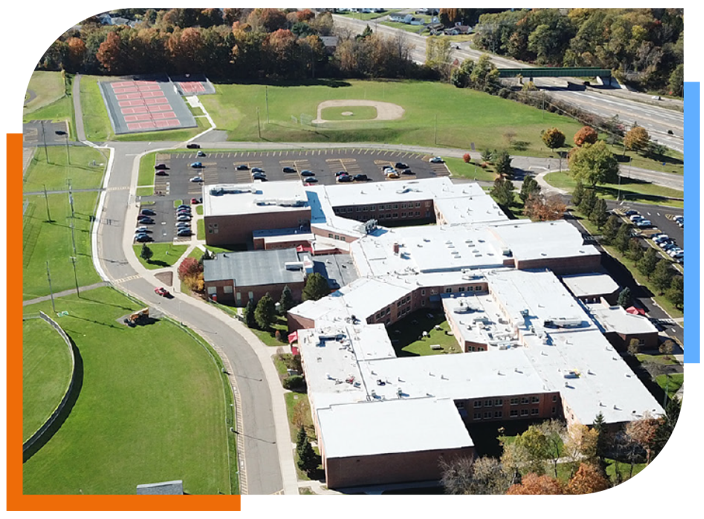
Located in South Central New York near the Pennsylvania border, Chenango Valley Central School District supports 1800 students across more than 380,000 square feet of educational facilities.
The district landed on Follett Software’s Facilities Suite to enable the automation of both internal and external community event scheduling, including public and private web calendars, finances and work orders for event set up and tear down.
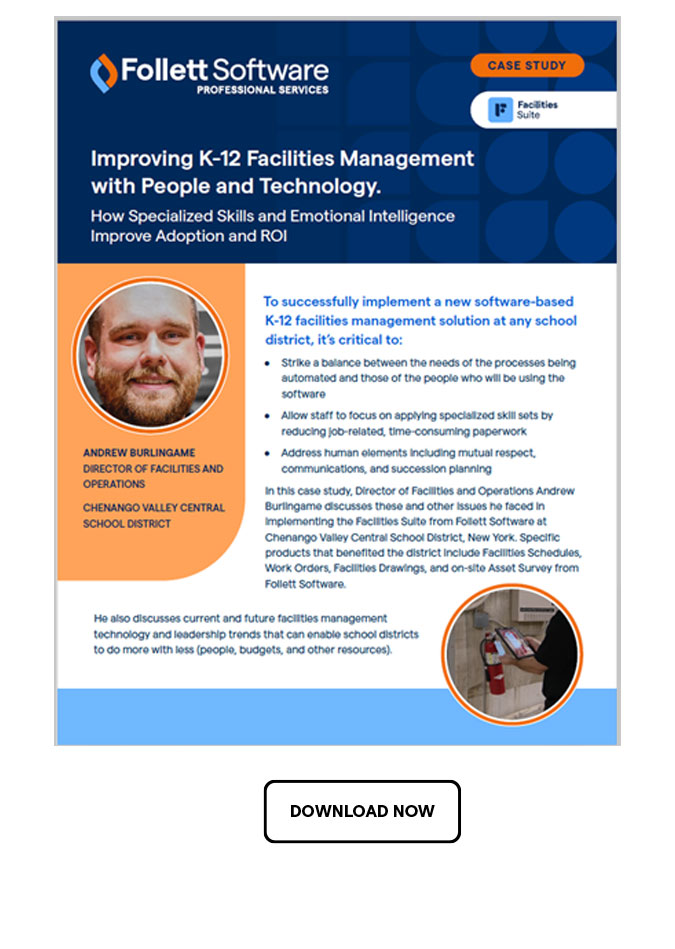 How Specialized Skills and Emotional Intelligence Improve Adoption and ROI
To successfully implement a new software-based K-12 facilities management solution at any school
district, it’s critical to:
- Strike a balance between the needs of the processes being automated and those of the people who will be using the software
- Allow staff to focus on applying specialized skill sets by reducing job-related, time-consuming paperwork
- Address human elements including mutual respect, communications, and succession planning
In this case study, Director of Facilities and Operations Andrew Burlingame discusses these and other questions he navigated while implementing the Facilities Suite from Follett Software at Chenango Valley Central School District, New York. Specific products that benefited the district include Facilities Schedules, Work Orders, Facilities Drawings, and on-site Asset Survey from Follett Software. He also discusses current and future facilities management technology and leadership trends that can enable school districts to do more with less (people, budgets, and other resources).
Starting from the Ground Up
Andrew’s path to Director of Facilities and Operations at Chenango Valley Central School District (CVCSD) was, in many ways, developed from the ground up. Starting as a summer laborer where he was introduced to the custodial side of facilities management, Andrew advanced to Second Shift Custodial Supervisor at Union-Endicott CSD, New York, followed by a stint as Elementary School Head Custodian. He also finished his associate degree in School Facilities Management from Mohawk Valley Community College in 2017. It was about this time that he saw the Facility Director position opening at Chenango Valley CSD. “I applied on a whim because I wasn’t expecting anybody to hire a 24-year-old director of facilities,” Andrew explained. “But they took that chance.” Located in south central New York State, just a few miles north of the Pennsylvania border, Chenango Valley Central School District is nestled on the banks of the Chenango River. The district has a full-time student enrollment of about 1,800 students in two elementary schools, one middle school, and one high school, with a total interior space of about 381,600 square feet.
From Paper to iPad
When Andrew accepted the director position at CVCSD, the district was using two facility management systems that were ripe for improvement: paper-based facility use requests and work orders via a competitor’s maintenance software.
- The paper-based facility use request system was especially cumbersome. Accidental double bookings, slow response times, and manual entry and tracking in spreadsheets wasted valuable time, increased the likelihood of errors, and underutilized facilities for students, staff, and community.
- The competitor’s platform was not designed around the unique needs of K-12 facilities, making it difficult to learn and use. Pricing and lack of responsiveness to feature requests were also issues that inhibited usability and return on investment.
Two of the first goals of implementing the new Work Orders software at Chenango Valley CSD were to eliminate paper while creating a secure web-based repository of the district’s facility data.
Despite the fact that the previous work order system was cloud based, district maintenance staff “just printed all the work orders, so it was still paper based,” Andrew noted. “Someone would see the work orders in the system and print them all and be like, ‘Here you go, Frank. Here’s your stack of papers. Work on these tasks.’ I think some of the maintenance guys were upset when I started because when we cut over to Work Orders, I was like, ‘All right, paper’s done. Everybody’s getting an iPad. Here you go.’”
To get team buy-in and educate them at the same time, Andrew planned a staged implementation of the software focusing on maintenance staff and supervisory custodians. As could be expected, adoption by staff and contractors varied based on the level of comfort with technology as well as legacy habits that were hard to break.
“‘Frank, you’ve got 18 work orders that are still open. What’s going on?’ ‘I got them done, I just can’t get logged into the iPad.’ ‘Well, let’s work together to figure this out.’” After a few months of additional coaching and accountability to close completed work orders electronically, the system was running smoothly for district staff and contractors. “Yeah, it was great. The staff all go in now and close their own work orders. Some of them put notes to communicate back and forth with the teachers.”
 Mutual Respect and Learning
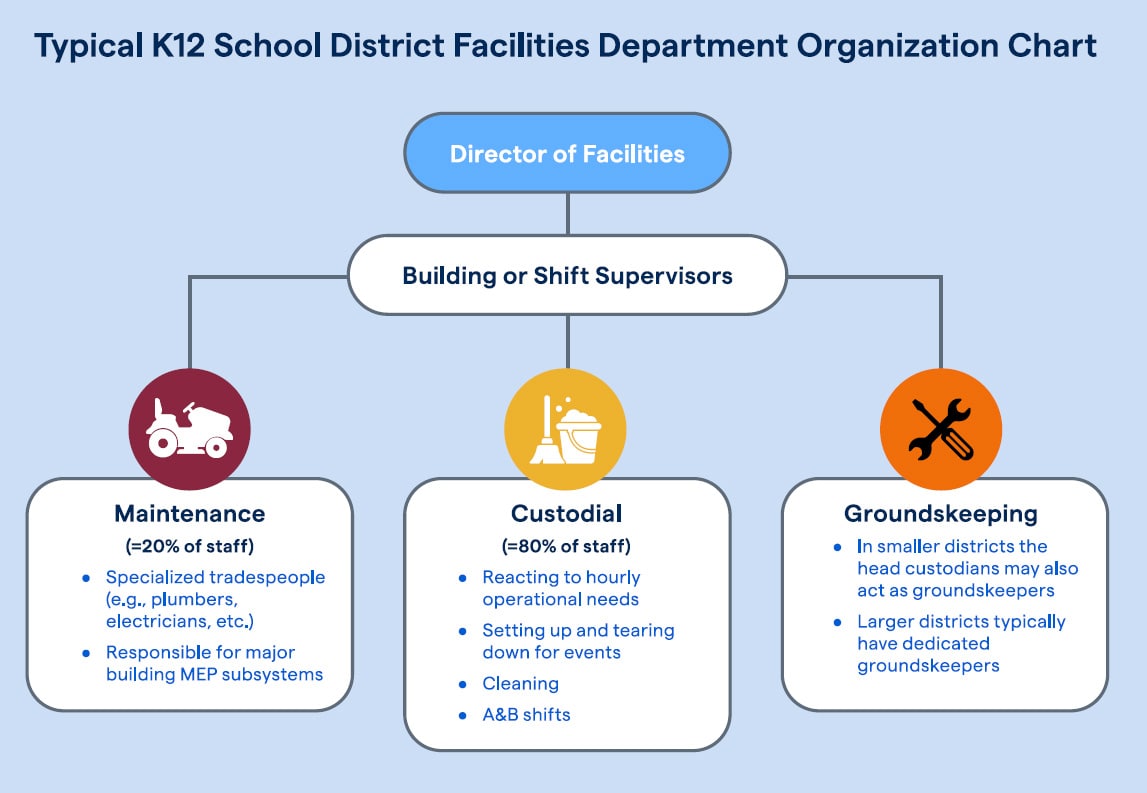
While Andrew had varied experience on the janitorial side of the facilities maintenance equation, he admittedly lacked that depth of knowledge about building and facility asset maintenance. As he explained, “As head custodial you do minor plumbing and outlet repairs, small stuff like that. But I didn’t have real maintenance experience, which I wanted to learn. So my crew has really helped educate and develop me in very usable ways,” as it relates to Work Orders, Andrew noted.
“I really focused on building those relationships with the maintenance guys to learn about their challenges and better understand their profession. I’m comfortable telling them I don’t know something. So I’m going to need your guys’ help a lot, just like they need my help to put together the budget.” One continued focus of Andrew’s is recognizing the unique skill sets of maintenance, custodial, and cleaning staff and finding ways to let everyone focus on their assigned work, instead of paperwork.
While Chenango Valley CSD’s supervising custodians have access to Work Orders, Andrew would like to have a set of preventative maintenance (PM) work orders that could be assigned directly to cleaners just like custodial and maintenance orders. “In addition to cleaning procedures I’d like to assign some PM procedures to check your fire extinguishers and those kinds of tasks. Custodians really don’t need to do that; it can go right to the cleaners who can verify that their sections have been done themselves to automate some of the custodial supervision too.”
Probably the single-most important piece of advice Andrew provided was the need for two-way communication and flexibility to act accordingly. “The biggest thing is to communicate often and well, get it in front of your staff. ‘Hey, this is what we’re planning on doing and why. I want you all to take an active part in the process.’ I got some pushback on putting all this in there, but I was always about the more you put in, the easier we can help you. ‘You want 20 tables set up? Great, we’ve got it.’ It’s already been communicated.”
 Next-Generation Facility Managers in Practice
“Facilities management and associated trades such as electricians, mechanics, and plumbers are great career paths for students who like working with their hands and want a well-paying, meaningful job that makes a tangible impact in their communities. “In high school, I never knew that there was a director of facilities,” Andrew admitted, although he’s trying to change that. To get students interested in the career possibilities, Andrew actively works to expose interested students to different aspects of facilities management. For example, a returning summer student employee is looking at construction project management as a possible career; Andrew will teach him about an active LED lighting replacement project with a budget just under $1,000,000. The students really thought it was cool. I had one student come down and sit with me for a couple of periods a day for a week to get a deeper look at a day in the life of a facilities manager. It’s good to get these topics in front of students because it’s a great career.” Succession planning is also always on Andrew’s punch list. “How can I coach the next maintenance guy to move up and become an assistant director or a director? A couple of my maintenance staff have 30-40 years of experience in the district. I’m trying to extract that knowledge and put it somewhere where I can go back and get it without having to call them.”
 Future Technology and Leadership Trends
The future of facilities management lies at the intersection of more embedded technologies and the critical thinking skills of proactive managers, maintenance professionals, custodians, and contractors.
Some of the technological advances Andrew foresees in the coming years include:
- Artificial Intelligence (AI), which he is currently using to help develop more specific preventative maintenance procedures to load into Work Orders. The use of AI to collect and analyze data to make practical recommendations will lead to predictive maintenance that will further extend the usable lives of facility assets. “We [K-12] will probably follow the industry norms a little slower, but it’s interesting; technology really is the huge push today.”
- Autonomous equipment such as floor scrubbers that dock and charge themselves, dump the water out, and refill themselves. This equipment can also be integrated with building systems to provide access to elevators for multifloor assignments.
- More sophisticated software integrations that harness the power of AI to better leverage facility data in everything from capital planning and project management to resource management including people, equipment, and supplies.
- Selecting responsive software providers who listen to real-world product feedback and integrate suggestions into future updates. Long-term, mutually productive relationships are critical to products that meet needs. For its part, the Work Orders development team is already working on incorporating more custodial cleaning preventative maintenance procedures into a future upgrade, as well as automated completion satisfaction surveys, thanks to Andrew’s and other districts’ requests.
But it will always be people – facilities professionals in this case – who will drive the technology.
Some current and future trends and issues on which Andrew is focusing include:
- Shared resources among smaller districts. “Working together is the biggest thing that’s going to help the schools as we move forward. Resources are going to be more and more limited.” Chenango Valley CSD has a history of collaboration with adjacent districts to share specialized equipment such as stump grinders among properly trained staff.
- Continued importance of in-person networking at events like NYS School Facilities Association (SFA) chapter and statewide meetings. “Conversations among the NYSSFA members are huge. That networking is much more valuable than I ever thought it was,” Andrew explained. “You can be active and engaged and learn from that, and make yourself, and hopefully your school district, better.”
- Focusing on soft skills. “I think that a lot of facilities managers are going to have to look into their staff training and quality control. You know, start hiring people with those types of skills, not just based on what they’ve done,” Andrew predicted. “They’re soft skills. How do you interact with people? How do you handle constructive criticism? You know, that kind of stuff. I can teach you how to mow the lawn, but I can’t teach you to just show up every day.”
Related Product:


Improving K-12 Facilities Management with People and Technology
Case Studies
January 15, 2026

How a Seamless SIS Transition Sparked Long-Term Success and Regional Leadership
Case Studies
September 22, 2025

How Lindbergh Schools Streamlined Operations with the Follett Facilities Suite
Case Studies
May 7, 2025

Campbell County Schools: Driving Innovation and Equity with Aspen Student Information System
Case Studies
May 1, 2025

How Alexandria Public Schools Transformed IT Support with IT Help Desk
Case Studies
March 3, 2025

Reigniting Student Engagement in the Digital Age with Follett Destiny® Engage™ and Add-On Tools
Case Studies
February 27, 2025

How Johnston County Public Schools Achieves Their Goal of Less than 1% Device Loss
Case Studies
February 7, 2025

Lexington School District Two: Transforming Classroom Library Management for Efficiency and Equity
Case Studies
February 5, 2025