
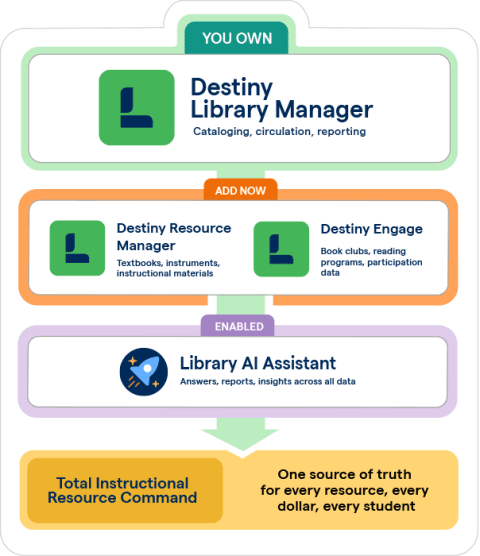
Total Instructional Resource Command
Destiny Library Manager + Destiny Resource Manager + Destiny Engage + Library AI Assistant
From Library Command to Districtwide Instructional Command. Curriculum and Library Leaders, add Follett Destiny® Resource Manager and Destiny Engage and enable the embedded AI Assistant on the platform your district already trusts. One source of truth for every textbook, curriculum resource, and instructional dollar in the district.
-
65%
of US districts already on Destiny
-
151M+
assets already managed in Destiny
-
30 to 90
days average to full impact
-
97%
annual renewal rate
Built for Curriculum and Library Leaders Ready to Turn Library Strength into District-Wide Accountability
Who This Is For
This is an upgrade conversation with two main stakeholders: library and curriculum leadership.

Curriculum Director / Resource Manager
You manage millions in instructional resources with spreadsheets and legacy tools. You need one source of truth that can answer the superintendent’s questions in seconds, not weeks.
District Library Director
You already run Destiny. You know the value of a real system of record. Now you can extend that same discipline to the rest of your district and position the library as the operational anchor for all instructional accountability.
District Administrator
You need instructional resources tracked, budget requests backed by data, and compliance reporting that does not require a fire drill. One platform across the whole district.
Superintendent
You need answers when the board asks about instructional spend, equity, and resource accountability. Not estimates. Not a week later. Now.
CFO / Finance
You need utilization data, audit-ready compliance reporting, and a total cost of ownership argument that consolidates tools rather than adding them.
CTO / IT Director
No new platform. No new IT setup. Resource Manager, AI Assistant, and Destiny Engage run on the Destiny infrastructure you already manage.
Visibility Pays.
The District Opportunity
Your district owns more than it knows. Outside the library, millions of dollars in instructional resources run on spreadsheets, legacy tools, and gut feel.
No Answer for ”What Do We Own?”
You manage millions in instructional resources with spreadsheets and legacy tools. You need one source of truth that can answer the superintendent’s questions in seconds, not weeks.
Resources Lost and Unaccounted For
Textbooks walk out. Instruments and equipment disappear. Science kits scatter. US public school spending on instructional materials is $18.9 billion, which means even a small percentage lost due to poor tracking can create substantial waste and avoidable repurchasing. Most of it is recoverable with the right system in place.
Source: Source: MDR’s Public School Buying Power Map
Equity Hard to Prove
Equitable distribution of instructional resources is a board priority and a legal requirement in many districts. Without real data, it is a promise, not proof. The answer lives in a spreadsheet no one trusts.
Patchwork of Disconnected Tools
Most districts run three or four platforms to cover what one system should. Library on Destiny. Assets on something else. Engagement somewhere else. Data lives in silos. Reports take weeks.
End-of-Year Reconciliation Is a Fire Drill
Every spring, curriculum teams, librarians, and asset managers spend weeks reconciling inventory across disconnected systems. That work should take days, not weeks, and it should produce audit-ready data automatically.
Budget Built on Estimates, Not Data
When next year’s instructional materials budget is based on “last year plus inflation” or principal requests, the district is flying blind. Utilization data is what turns a budget request into a defensible ask.
Only the Destiny Platform Connects Library, Resources, and Engagement Data Across the Entire District.
What You Unlock
Competitors offer general resource tracking. Destiny delivers K-12 depth, instructional context, and a proven track record at scale.
Unlock Visibility
Know what your district owns, where it is, and what it is doing. End the spreadsheet era of instructional resource tracking for every textbook, instrument, kit, and piece of equipment the district owns.
- Real-time view of every instructional resource district-wide
- Allocation tracking by site, classroom, and student
- Digital storage replacing spreadsheets and standalone tools
- The AI Assistant answers “what do we own” in seconds
- One source of truth across library and resource data
Unlock Accountability
Demonstrate equitable distribution, prove ROI on instructional spend, and answer board-level questions with confidence. Data that holds up in a budget meeting, a compliance audit, and a board presentation.
- Equitable distribution visible by school and classroom
- Utilization data to defend every budget request
- Title I and federal compliance reporting built in
- Lost and unaccounted resources tracked and recoverable
- Budget request data by building and collection type
Unlock Time
Give curriculum directors, resource managers, and librarians their hours back. Hours that should be on instruction and students, not on spreadsheets, reconciliation projects, and manual reports.
- The AI Assistant builds reports in seconds
- End-of-year reconciliation collapses from weeks to days
- Resource Manager replaces manual tracking workflows
- Destiny Engage automates participation reporting
- One login across all products, no context switching
Unlock Outcomes
Connect what your district owns to what your students learn. Move from tracking inputs to demonstrating outcomes. The library and the curriculum team finally have a shared evidence base for impact.
- Destiny Engage drives measurable reading participation
- Resource Manager shows instructional utilization
- AI Assistant connects library, resource, and engagement data
- Curriculum and library teams share one impact story
- Expansion path to the Technology and Facilities Suites
Two Departments. Two Returns. Both Real.
The Return on Investment
Instructional Resource Command pays back the curriculum owner in accountability and budget control. It pays back the librarian in time.
Curriculum Owner ROI
Budget, accountability, and district-level control.
- Defensible budget asks backed by utilization data
- Equitable distribution proven, not assumed
- Lost and unaccounted resources reduced and recoverable
- Faster answers to superintendent and board questions
- End-of-year reconciliation in days, not weeks
- Compliance reporting without a fire drill
Librarian ROI
Time back. Impact visible. Role strengthened.
- Reports run in seconds, not hours
- Bulk actions replace title-by-title work
- Insights surfaced automatically, not after a data pull
- More one-on-one reader advisory conversations
- More time co-teaching with classroom teachers
- Library positioned as the district’s operational anchor
Products Built for the Platform You Already Own
What You Add
Same Destiny foundation. Same login. Same support relationship. No new vendor or IT setup.

Destiny Resource Manager
The accountability system.
District-wide visibility into all instructional resource. The data layer that makes budget decisions defensible.
Track, manage, and allocate every instructional resource your district owns. Textbooks, classroom materials, science kits, instruments, equipment. One place. One source of truth.
What You Unlock
- District-wide resource catalog and check-in/check-out
- Usage tracking by school, grade, and subject
- Title I and federal compliance reporting
- Resource age and condition tracking
- Budget request data by building and collection type
- AI-powered gap/usage analysis on demand
- Same login and platform as Library Manager
Destiny Engage
The reading culture layer.
Reading programs and engagement at scale. Curriculum and library teams, connected.
Transform readers, not just book borrowers. Destiny Engage gives curriculum leaders and librarians a shared, measurable engagement layer that connects instructional resources to literacy outcomes.
What You Unlock
- Book clubs and reading competitions in minutes
- Bulk title assignment from the Library Manager catalog
- Participation tracking at club, student, and title level
- Teachers and librarians with shared literacy visibility
- Measurable literacy impact for district leaders
Library AI Assistant
The productivity and insight layer you already own.
Answers across library and resource data. Already live in 810+ districts today.
AI that works across both library and resource workflows. Curriculum owners ask “are our science kits being used” and get an answer, not a data pull. Librarians get board-ready reports in seconds.
What You Unlock
- Plain-English answers from your actual district data
- Insights across library and resource allocation
- Collection gap and utilization analysis on demand
- Auto-generated board and leadership reports
- Recommendations powered by real data, not generic models
- Student data never used for training
+ Optional Add-On
Destiny District Classroom Library Manager
For districts that want to bring the same accountability discipline into every classroom library. Most classroom libraries today are invisible to district leadership. District Classroom Library Manager closes that gap.
- District-wide visibility into every classroom collection
- Funding source tracking and equity reporting across classrooms
- Teacher-facing check-in, check-out, and inventory tools
- Title I tracking at the classroom level with audit-ready reporting
- Protection of classroom investments that today walk out the door
The Platform Is Already Proven.
The Outcomes Are Already There.
We are now able to see in real time an accurate inventory and move materials as needed.
Assessment and Accountability, St. Mary’s County Public Schools
Library Manager Alone vs. Instructional Resource Command
The library foundation does not change. What the entire district can do with it does.
Before and after
Why Destiny Wins the Resource Management Conversation
AGAINST THE ALTERNATIVES
Curriculum owners often ask why Follett over a generic asset management system, an ERP module, or the status quo.
Spreadsheets and the Status Quo
Why it falls short: Every district has them. None of them scale. Data is stale the day it is entered. No one trusts the numbers when budgets are on the line.
Why Follett wins: One real-time source of truth, tied to the Destiny platform your library already runs on. Defensible to your board on day one.
Generic Asset Management Systems
Why they fall short: Built for warehouses, not schools. No K-12 workflows. No curriculum context. No connection to library or literacy data.
Why Follett wins: Purpose-built for K-12, around teachers, students, and curriculum. Connected to the library data your district already trusts.
ERP Modules and Finance Tools
Why they fall short: Designed for finance teams, not curriculum teams. Hard to use. Hard to see student impact. Curriculum staff opt out.
Why Follett wins: Built for instructional accountability, not finance compliance. Curriculum and library teams actually use it. Finance still gets the data they need.
Digital-Only Content Platforms
Why they fall short: Manage digital content, not library or instructional operations. No print integration. No inventory. No district analytics.
Why Follett wins: Operational depth with print and other physical items and digital together. Library and instructional resource picture in one place, not two.
Legacy Library or Resource Platforms
Why they fall short: Not cloud-optimized. Limited analytics. Poor UI. No classroom library support. High maintenance overhead for IT.
Why Follett wins: Modern cloud platform with AI built in, classroom library support included, lower total cost of ownership, and lower IT burden.
Funding Pathways Your CFO and Curriculum Team Will Recognize
BUDGET AND FUNDING
This is an extension of an existing investment. Funding options are established and well-documented for both library and instructional resource purchases.
Title I
Destiny Resource Manager may qualify for Title I funding when used to track and ensure equitable distribution of instructional materials. Classroom Library Manager adds classroom-level Title I tracking with audit-ready reporting.
Strong fit for districts with equity reporting requirements or Title I compliance obligations.
Title IV-A
Library technology and reading engagement platforms may qualify for Title IV-A funding when they support Well-Rounded Educational Opportunities or Effective Use of Technology.
Your existing Library Manager contract may inform the documentation. Verify eligibility and allowable use with your district’s federal programs coordinator.
Wisconsin Common School Fund
Wisconsin districts must designate unspent Common School Funds by June 30 each fiscal year. Library technology, including Destiny Engage and Library AI Assistant, may qualify under this program.
Speak with your board to verify eligibility.
E-rate Category 2
Qualifying districts may be able to apply E-rate Category 2 funds toward eligible technology infrastructure supporting the library platform. Eligibility depends on district-specific E-rate applications and FCC program rules.
Verify eligibility with your E-rate coordinator or district technology director.
Total Cost of Ownership Note for CFOs
Most districts already pay for some version of resource tracking, somewhere. Instructional Resource Command consolidates those costs onto the platform you already pay for. The harder budget question is how much instructional spend is currently unaccounted for. Recovery from better tracking typically pays for the upgrade.
What Your District Decision Makers Need to Hear
INTERNAL ALIGNMENT
This is a multi-stakeholder decision. Here is how to frame the upgrade for each.
Curriculum Director / Asset Manager
Needs: visibility, budget defensibility, equitable distribution, compliance
Destiny Resource Manager gives you a real-time view of every instructional resource across every site. You stop estimating and start proving. Utilization data defends every budget request. Equitable distribution is visible and auditable. End-of-year reconciliation goes from weeks to days. And you are doing it all on the platform your library team already trusts.
District Library Director
Needs: extending library value, time back, strategic positioning
This extends the discipline you already built in the library to the rest of the district. You become the operational anchor for all instructional accountability, not just the library. The AI Assistant returns hours to your team every week. Destiny Engage connects library programs to measurable literacy outcomes. Your role in the district grows.
Superintendent
Needs: board-ready answers, equity, district accountability
When the board asks “what does the district own and are we distributing resources equitably,” your team answers in seconds, not weeks. No new vendor. No new risk. The platform 65% of US districts already trust, doing for the whole district what it has been doing for the library all along.
CFO / Finance
Needs: total cost of ownership, audit readiness, consolidation of tools
This consolidates tools, not adds them. Destiny Resource Manager replaces spreadsheets and standalone asset systems with one platform that is already IT-managed and already supported. Title I compliance reporting is built in. Total cost of leadership goes down. Recovery from better tracking typically pays for the upgrade.
CTO / IT Director
Needs: no new IT setup, data governance, AI safety
There is no new platform to manage. Destiny Resource Manager, Destiny Engage, and the AI Assistant run on the Destiny infrastructure you already support. Same SSO. Same data environment. Student data is never used to train AI models. Your team activates three products, not a new system.
Questions You Will Hear.
Answers That Hold Up.
COMMON OBJECTIONS
-
Most districts running a separate asset tool or spreadsheet have a reconciliation problem: when the librarian and the curriculum director need to answer the same question, they ask each other and manually reconcile. Destiny Resource Manager replaces that with one source of truth, built for K-12, on the platform your library already runs on.
-
Resource Manager is built for instructional accountability, not finance. It tracks what students are using, where the gaps are, and how to make resource decisions that improve instruction. Finance benefits from the data, but the primary buyer and primary user is the curriculum team.
-
Most districts already pay for some version of resource tracking. Resource Manager consolidates those costs onto the platform you already use, with no new vendor to manage. The harder budget question is how much instructional spend is currently unaccounted for. Recovery typically pays for the upgrade.
-
Destiny today is a modern cloud platform with AI built in, classroom library and literacy support, and analytics that meet the standards finance and curriculum teams demand. 810+ districts are already running our AI tools today.
-
There is no other system. Destiny Resource Manager, Destiny Engage, and Library AI Assistant share the same login, navigation, and interface as Library Manager. Your library team already knows the platform. Your curriculum team picks it up in hours, not weeks.
-
Library AI Assistant is already live in 810+ districts. It is assistive, not autonomous. It surfaces information faster and runs reports your team would otherwise build manually. K-12-specific guardrails. Built by the partner you already trust.
A Short Conversation. A Fast Path to Full Command.
WHAT HAPPENS NEXT
You already have the platform, the relationship, and the data foundation. Getting to full Instructional Resource Command is a shorter path than most districts expect.

Upgrade Conversation
30 minutes. We review your current Library Manager setup and confirm which Destiny Resource Manager, AI, and Destiny Engage capabilities are ready to activate for your district.
District Walkthrough
We walk through the bundle in the context of your district’s resources, catalog, and accountability goals. Real scenarios for both the curriculum team and the library team.
Budget and Approval
Your Follett partner provides budget language, funding documentation, and ROI framing for both the curriculum owner and the library director approval paths.
Full Impact in 30 to 90 Days
Most districts reach full impact in approximately 30 to 90 days. Follett onsite inventory services can compress asset tagging from months to weeks. No migration. No new IT setup.
Answers for the People
Who Need to Say Yes
Common Questions
-
Most districts running a separate asset tool have a reconciliation problem: when the librarian and the curriculum director need to answer the same question, they ask each other and manually reconcile. Destiny Resource Manager replaces that with one source of truth, purpose-built for K-12, on the platform your library already runs on. No new vendor. No new IT setup.
-
Destiny Resource Manager is built for instructional accountability, not finance. It tracks what students are using, where the gaps are, and how to make resource decisions that improve instruction. Finance benefits from the data, but the primary buyer and user is the curriculum team.
-
Most districts reach full impact in approximately 30 to 90 days. Because Destiny Resource Manager, AI, and Destiny Engage run on the Library Manager platform you already maintain, there is no migration. Follett onsite inventory services can compress asset tagging from months to weeks.
-
Student data is never used to train AI models. It operates entirely within your Destiny environment on your district’s catalog, circulation, and resource allocation data.
-
Yes. Destiny Resource Manager may qualify for Title I funding when used to track equitable distribution. Title IV-may also apply when it supports Well-Rounded Educational Opportunities or Effective Use of Technology. Qualifying districts may be able to apply E-rate Category 2 funds toward eligible technology infrastructure supporting the library platform. Wisconsin districts should note the June 30 Common School Fund designation deadline for library technology. A Follett partner can provide documentation and budget language.
Your District Already Has Command of the Library. Now Extend It to Every Classroom.
One conversation with your Follett partner is enough to see what Instructional Resource Command makes possible for your district. No new vendor. No new platform. Just the visibility and accountability your district has needed.
